Introduction
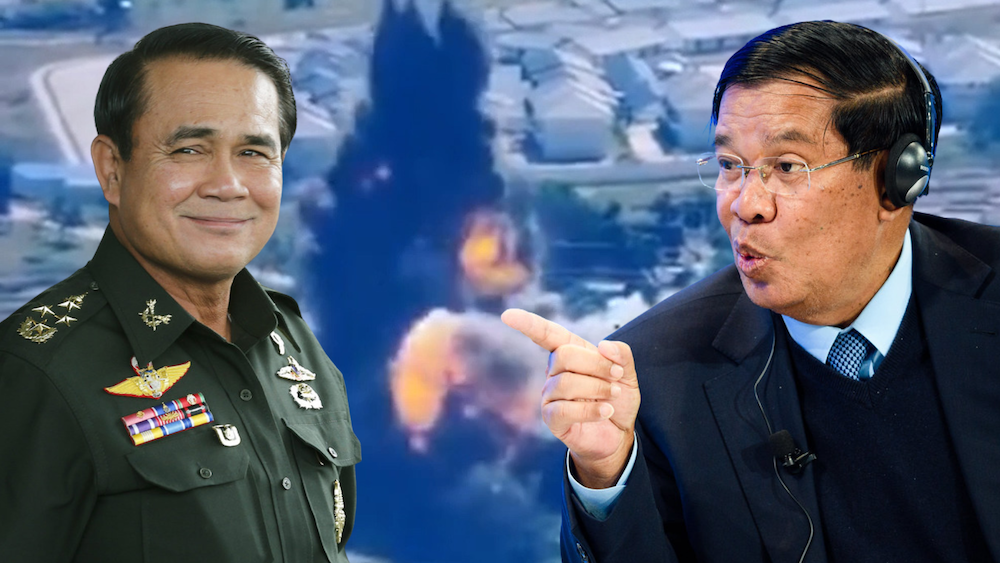
Armed clashes between Thailand and Cambodia have that been happening intermittently since the 1950s flared up again in 2025. With smartphones and social media allowing videos of the rockets, explosions and damage to be seen more widely than ever before, the conflict has appeared to be more extreme than previous clashes in 2008 and 2011.
Tensions increased most recently when confrontations began between citizens of the two countries visiting the ancient Khmer temple, Prasat Ta Krabey or Prasat Ta Khwai, which sits on a disputed strip of land between Surin in Thailand and Oddar Meanchey in Cambodia. One example of the arguments increasing came in June when Cambodians sang their national anthem at the temple before Thai soldiers intervened and calmed the situation. This particular topographical dispute dates to the Franco-Siamese Treaty of 1907 when a border line was drawn up. Thailand claims that hand-drawn maps from more than a century ago are ambiguous, inconsistent and mismatched with the terrain. Modern-day satellites can pinpoint the watershed along the mountain range more accurately and this would be decisively in Thai terrain, they claim.
The International Court of Justice ruled in 1962 that the nearby Preah Vihear was in Cambodian territory but there has never been a decision on Prasat Ta Krabey. Neither side has taken this specific case to the international courts and neither can agree through bilateral discussions. Though the temple is more easily accessible from the Thai side, the cas has remained unresolved for decades.
This febrile atmosphere continued but worsened significantly when a Thai soldier patrolling the region was injured by a landmine in late July. Thailand maintains that this was a recently-laid landmine, constituting an act of war and a serious breach of the Ottawa Treaty, which has banned the use of anti-personnel landmines and of which Cambodia is a signatory.
The following day, gunfire began between the two sets of soldiers at around 8am. Both sides claim the other opened fire first. However, later that same day, Cambodian soldiers fired BM-21 grad rockets into the Thai province of Si Sa Ket, where they struck a 7-Eleven store and PTT petrol station killing eight civilians and injuring 13 others. Cambodian shelling also hit residential areas in Buriram, Surin and Ubon Ratchathani. At least 14 civilians were killed in total across the border region and many more injured, Thailand’s Health Ministry has reported.
To Thai military chiefs, this was an act of war. Striking civilian targets was also a serious breach of international humanitarian laws. A military response was inevitable.
The border
Thailand did not unleash its military might immediately and recklessly. It began with the decision to enforce the border between the countries.
Thailand and Cambodia share a border stretching 508 miles from Ubon Ratchathani in the northeast to Trat in the east. Much of the border was drawn by the French using watershed lines as vague territorial markets. Perhaps the then Prime Minister Georges Clemenceau thought it of little importance, or had little interest, in putting physical markers down. The lack of clear demarcation has had a knock-on effect more than a century later.
There are several checkpoints for crossing by road, such as the Chong Chom–O'Smach border in the north or the Chong Sa‑Ngam–Anlong Veng border crossing between Sisaket and Oddar Meanchey, but the majority is uninhabitable land. Where there are suitable areas, several Cambodian settlements have appeared, with many near undemarcated or disputed stretches. Thai authorities have long been aware of these encroaching villages, many of which grew during the tumultuous years of the Cambodian civil war, the Khmer Rouge reign and then the Vietnamese occupation. Some villages sit on or just north of the watershed line defined in the Franco-Siamese Treaty of 1904, which Thailand treats as the legal boundary.They are made of small wooden or bamboo houses, corrugated metal roofs, unpaved lanes and have limited drainage. There are informal electricity cables and shared wells. Often there are no physical boundaries separating them from Thailand or forests. Many residents lack formal land titles recognised by either state.
Former Thai PM Prayut Chan-o-cha was asked about these villages and replied that Thailand simply ‘tolerated’ them. They were harmless… until they weren’t harmless, has been the prevailing view. That change in mindset from Thailand came following the July 24 attacks. Thailand viewed them as a danger for undocumented Cambodians entering the country illegally, which it claimed posed a danger to national security.
Thai troops immediately set about rolling out razor wire and old tires as a crude border wall. There was even an appeal by the military for the public to donate barbed wire. In one incident, Thai police fired tear gas and rubber bullets at Cambodian civilians as they reclaimed a disputed border area on September 18. Such scenes were repeated at multiple locations with tyres and razor laid out in a Trump-esque border wall.
The military and political leaders said publicly that these measures were necessary to protect Thai nationals living in border villages and to protect national security. This has all played into a boost in nationalism at a time when support for state institutions was flagging, particularly among the young.
Political support and nationalism
Returning to Bangkok in August from a brief trip abroad, it was possible to believe that a jubilee or coronation was in progress. Skyscrapers were illuminated in the national flag, billboards were displaying digital incarnations and airport displays were redesigned. Even motorcycle riders had miniature flagpoles attached to their handlebars with those distinctive blue white and red stripes flowing in the wind.
Such a mood of fervent nationalism would have been inconceivable just a year before, when the liberal and reformist Future forward party won the national election vote. Support for the party was strong in cities, among the educated and the young. One of their core manifesto pledges was to end compulsory national service and reform existing laws that ban criticism of the monarchy. This was not excessive reform, just a mild dilution of what are some of the strictest statues in the world. But even that was too much for the establishment figures in Bangkok to contemplate. Having won the election, the leader, Pita Limjaroenrat, was swiftly found to have breached election rules and banned from politics, in what many saw as a politically motivated ruling by the court. The party was later disbanded.
But the risk did not disappear. The party was rebranded, albeit with the same elected politicians. Pita is still waiting for his time in the sin bin to expire, as is the charismatic founder Thanathorn Juangroongruangkit, who unsurprisingly, was also banned from politics in 2019 when he became extremely popular amid a surge in support for his new party, which was formed just a year earlier. For Thailand’s ultra-conservative and ultra-paranoid elite, the threat has remained and will only grow in the coming years. Something drastic needed to be done.
The surge in patriotism that has seen support for the military, and to some extent, the monarchy, rise among those who were previously reformist, could be viewed as a coincidence. A fortuitous effect of defending one’s country. Karma, the leaders may say. Thai people have seen the army keeping them safe, soldiers giving their lives to protect the country. They appreciate the military now. In this regard, the army may have a point. Thailand is undoubtedly safer in times of conflict than its neighbour. That’s entirely down to the defence budget and the highly advanced capabilities of the military that leaders have been developing over the years, even in the face of public criticism, such as the costs of a long-running programme to buy submarines. Finally we’re getting some recognition for that hard work and future planning, the army would say. We did know best, the formerly maligned junta leader Prayut Chan-o-cha would undoubtedly claim.
A less generous view is put forward by Cambodian commentators who accuse Thailand of engineering the conflict, or at the very least, prolonging the clashes, in order to rally nationalist support for impending elections. This is not an uncommon theory during wars, when politicians use the conflict to generate support or distract from political troubles at home. Although there are plenty of domestic issues that Thailand is struggling with domestically, this would imply that Thailand allowed, or even conspired with Cambodia, to launch the July 24 attacks.
Plus, the same accusations could also be levelled at Hun Sen, whose brand of authoritarianism is increasingly out-of-step with the country’s young, as well as the international community, which increasingly ties human rights and democracy to aid, military support and financial investment. A lack of public support could weaken the grip he has maintained on control, particularly when he passes away and a power vacuum is left that power-hungry factions will seek to fill. A war against a powerful neighbour has rallied nationalistic fervor in Cambodia the same way it has in Thailand and Hun Sen and his son, Hun Manet, will benefit from that, too. Hun Sen used a similar conflict with Thailand over the Preah Vihear temple complex to drum up nationalist support before elections in 2008 and again during clashes in 2011.
Robert Willard, the US Navy admiral in charge of American forces in the Pacific at the time, told a US congressional committee that Hun Sen was ‘building Hun Manet’s credentials as a military leader and hero who defended national sovereignty against an external threat’ by sending him to the overseas troops in the clashes.
Given that it was the July 24 attacks that triggered the conflict, the accusation that the conflict is being used to drum up political support is equally, if not more relevant to Cambodia, than Thailand.
Scam centres, mass financial fraud and friends falling out
The network of financial fraud hubs in Southeast Asia is perhaps more far-reaching and complex than anyone is fully aware. Estimates are that in Cambodia alone, the cyberscam compounds generate sums each year equivalent to half of the country’s GDP, according to the United States Institute for Peace. In 2024, Americans lost at least $10 billion to scam operations, with Southeast Asia-based networks a major driver. The issue is such a problem that Secretary of State Marco Rubio announced sanctions in September against four individuals and six entities for their roles operating forced labor compounds in Cambodia. The sanctions also included targets in Myanmar.
During this period in which the world decided enough was enough with cyberscam centres, Hun Sen and his former BCF (Best Corrupt Friend) Thaksin Shinawatra had a spectacular falling out. This culminated in Hun releasing a taped phone call with Thaksin’s daughter Paetongtarn Shinawatra, the then Thai Prime Minister, in which she spoke to him deferentially to ask for a resolution to the then border tensions. Thais were furious at their (un)elected leader seemingly prostrating to a rival military leader of a country whom most in Thailand regard as an uncouth cousin. Phatangtarn was promptly dismissed by the court like Pita before her and Thanathorn before him. Her reign as a nepo-PM pushed into place by her controversial father was over. As was Thaksin’s friendship with Hun Sen.
The cause of this dispute is another complex matter that adds another mirror to the already smokey hall of mirrors. It came at a time when Thaksin, ever the opportunist, was pushing for Thailand to legalize casinos. This move would have harmed one of Cambodia’s revenue streams and an industry that is widely seen as being a front for money laundering.
Following this debacle, an expose by investigative journalists revealed the murky world that Thaksin had been involved with. It included cryptocurrency schemes, a South African businessman named Benjamin Mauerberger, or Ben Smith, Chinese banking groups and, rather embarrassingly, a clique of high-ranking Thai politicians. Given that these networks and Mauerberger himself were based in Cambodia, it seems likely that the Hun clan are connected to the trail, as previous investigations have found that the financial fraud schemes operate with the approval of the highest echelons of government.
‘It is impossible to imagine that such vast wealth would be moving through the system without the explicit knowledge and participation of its strongman and his immediate circle,’ Jacob Sims, Visiting Fellow, Asia Center, Harvard University, said of the scam centres. The U.S. State Department’s Trafficking in Persons report criticised the ‘official complicity’ in the networks while Amnesty International said the ‘Cambodian authorities have deliberately ignored a litany of human rights abuses including slavery, human trafficking, child labour and torture’.
Given Hun Sen’s ruthless ability to extract money from every orifice of his country, from alleged illegal logging deals and alleged drug trafficking networks to international aid, land concessions and casinos, it would surprise few if he missed this particular hustle, even if he is yet to grasp the intricacies of decentralised cryptocurrency blockchains.
Much of the Thai military operation has focused on striking military targets and buildings used by these scam centers. Are they destroying the evidence? Are they creating a smokescreen to distract from their involvement? Culpability in transnational crime would certainly appear less likely if they are the ones fighting it strongest by blowing up the operating centres.
Australian commentator Tim Newton certainly believes they are an important factor in the conflict. The former CNN contributor describes them as the ‘elephant in the room’ and ‘probably the real reason behind some of the escalation in this conflict’.
‘I believe the main reason for the conflict has been casinos and scam centres and the connections to which various people very high up in the respective governments may be involved with and there seems to be a dismantling of the situation at the moment,’ he says in a broadcast on December 18.
Like father, unlike son
Hun Manet could not be more different in character than his despotic father. One is mild-mannered, educated at the finest schools, an economist by nature, with a fondness for the West, its sports and traditions. He was born into a level of comfort unbeknown to his paternal relatives. The other is a brutal street-fighter of a soldier scraping his way up from poverty, losing an eye in battle, seizing power and ruling like a tyrant with a visceral disdain for countries interfering in the serious business of enriching himself and his cronies. The shift from one to the other defines not just the current conflict but also how Cambodia will develop over the next two decades.
Hun Senior was born into the life of a rural peasant and as a child and had little more than a rudimentary education from the village monks. He may have grown up to be a rice farmer had fate not lured him to the capital Phnom Penh where he joined the upcoming Khmer Rouge.
Rising to become a senior commander, the young Hun helped to oversee the murder of millions of his countrymen in what was one of the world’s worst genocides. He eventually left, not through moral conscience, but when paranoia set in and he feared the Pol Pot inner circle was turning on him. From there he joined Vietnam to fight against his former comrades and successfully capture Phnom Penh, albeit under a foreign flag. Fortunately for Hun, he was quickly installed as Prime minister and could set about his agenda - slaughtering his political opponents, critics, journalists and anyone else who was a threat. It was going well until the international community interfered and decided to turn Cambodia into the world’s first United Nations run country. Hun now had to battle those and eventually with some clever thuggery, tanks and hand grenades, opposition were dispatched, the UN gave up, and deeply questionable elections quickly reinstated him as the leader from 1985 until this day, where he still oversees the senate, for now.
Hun Junior was born into luxury, thanks to the wealth plundered by his ever-industrious father, who was seemingly working miracles with his meagre Prime Ministerial salary of 2,490 USD a month, stretching it to buy fleets of luxury cars, build mansions, acquire watches, gold land, businesses and apartments and homes around the world - generally anything he or his family wanted for. This allowed the youngster to never have to struggle in the same way his father had.
Manet attended the prestigious West Point military academy, where he was quiet, reserved and well-liked. His roommate enjoyed his company so much that they roomed together the following year. The young Hun was intrigued by western rituals, such as hazing, and watched sports with amazement, even attending local baseball and basketball games. He completed a masters in New York before flying across the Pond to complete a Phd in Bristol, England. So humble was the young scholar that classmates and lecturers in the UK did not know of his family background until his studies came towards the end ‘Needless to say, more than a few eyebrows were raised,’ a lecturer told local media at the time. But the fondness for young Hun was genuine. He was well liked and academically gifted.
The prodigal son was eventually trusted enough to oversee government and following elections with an outcome already decided, he became Prime Minister on 2023, albeit with his overbearing father retaining power and influence as the President of the Senate of Cambodia.
There is no doubt that Manet is more refined and academic than Sen, who has little regard for the international community unless they are providing financial aid. Such is Hun Sen’s regard for international grace that he was so drunk during an official meeting with U.S. officials that he fell off a chair, according to Joel Brinkley in his phenomenal book Cambodia's Curse: The Modern History of a Troubled Land.
On another occasion, Sen raged at being ordered to follow ‘international standards’. ‘International standards are for sports,’ he said.
There is strong evidence that Manet is aware of the impossibility of ruling Cambodia the way his father has and is aiming to move the country in a different direction. For it is perhaps clear to Manet that if Cambodia is to develop, he must begin the multi-generational task of transforming the country. Plundering the country to enrich a few is not only unsustainable, as the state of the vast majority of rural Cambodia shows to this day, but it perpetuates the prevailing diplomatic view that Cambodia remains an outlier. Further, Manet, as an economist, likely realises that international trade, diplomacy and co-operation are the only route to Cambodia being taken seriously, not just by its neighbors in ASEAN, but by the international community and investors, which rely on human rights and transparency before moving vast sums of money (unless you’re China).
One aspect that Manet is trying to improve is relations with the US and in particular, Cambodia’s defence capabilities. The defence budget was a worryingly low 739 million USD in 2025, with chunks of that likely to be lost along the food chain of department officials and military figures. Increasing defence spending would be the first step in bolstering capabilities, with orders for new weapons.
The US cannot currently sell arms to Cambodia, due to its stringent rules. However, closer defence co-operation was on the agenda when Hun Manet and Hun Sen met US Defense Secretary Lloyd Austin at a meeting in Phnom Penh in June 2024. Although any directly military is unlikely in the short term, as Congress effectively bans military ties with regimes linked with human rights abuses and Cambodia is far too close to China, the talks were perhaps a starting point, and an untapped market for US arms manufacturers.
‘The relationship has a lot of potential and room for growth,’ said one US official.
If further evidence was needed, since becoming PM, Manet has reached a point where close to $300k a month is being paid to US lobbying groups, FAR filings show. The scale of spending and intent is clear. Thailand, in contrast, has a couple of small tourism officers and paid for a consultation on hosting the 2036 olympics. (The conversation for that could have been pretty short).
Cambodia, and in particular Hun Manet, clearly have ambitions for the country to develop. The new airport in Phnom Penh and its goal of rivalling Suvarnabhumi International Airport in Bangkok for a regional cargo and transport hub, shows this. While this could be seen as positive, the means to achieve it may be less so.
Could an armed conflict bring the US and Cambodia closer?
The US is the king of foreign wars. Many often have some degree of US involvement. And many are engineered to benefit the US. These current clashes could be no different.
At least five lobbyist groups have been hired. Notably, the initial escalation in conflict happened just after Trump loyalist Don Benton was hired in March 2025. Filings show that one organisation run by Benton produced documents to portray Thailand as the aggressor in regards to the removal of villagers on encroaching land.
What conversations were had between Benton and the Cambodian leaders? Was it suggested that a little bit of horseplay, a little fighting with a bigger neighbor, would put Cambodia into the eyes of the world, like the proverbial schoolboy picking a fight with the kid from the year above to show he’s a tough, or the low ranked boxer pushing for a fight with the belt holder, just to get a name for himself? A conflict with a bigger neighbor would give Cambodia a genuine case to claim they need better defence systems. It has certainly brought the country to the attention of the White House.
A close ‘friend’ of Benton is fellow Trump-toady Michal Alfaro, who mysteriously decided to wade into the conflict in August. He seemed intent on framing it with President Trump at the centre. Alfaro mentioned Trump numerous times during an unhinged diatribe close to the Thai-Cambodia border in August and even in December, was posting online about Trump. This would be in line with the motive of Cambodia paying the lobby groups. Perhaps more generously, the fixations of a lobbyist desperate to become relevant in Washington.
While publicly claiming to be a journalist, he was proven to have posted three faked or misleading pictures in a single week. An online post even accused Thailand of ‘running killing fields’, seemingly without irony or knowledge of what killing fields actually are.There was no evidence of the journalist standard of balance, impartiality or fairness, as is used by Reuters, Al Jazeera and others, which is of even greater importance in war time.
Such rhetoric increases hate between the two sides and makes peace harder to achieve. It costs lives. This was explained clearly during a meeting in August between General Thongchai Rodyoi, Chief of Staff of the Royal Thai Army, met Dr Andrew Byers, US Deputy Assistant Secretary of Defence for South and Southeast Asian Security Affairs.
This raises the questions of whether the lobbyists being paid by Cambodia are also using influencers, or digital political mercenaries such as Alfaro, to incessantly post online misinformation. Anecdotally there has been a rise in bot accounts on social media expressing support for Cambodia. Is this method being used to inflame the clashes in order to bring the US and Cambodia closer?
How a closer Cambodia-US relationship would affect Thailand
Thailand would seem to be the envy of Manet. They have been a US ally since the early 1960s, when CIA operatives used bars in the Patpong district of Bangkok to plan reconnaissance missions. Thailand provided military bases for Uncle Sam during the Vietnam war, and in return, the GIs gave Thailand Soi Cowboy and Pattaya. Possibly a fair trade deal - though the nightlife spots have lasted far longer than America did in Vietnam.
To this day, US marines hold annual Cobra Gold training exercises with the Thai army. For their good behavior, such as not firing rockets into civilian areas, they have been rewarded with F-16 jets. Though Thailand’s conduct is not quite good enough to get the F-18s, what with the occasional military coup and frisons with China (nobody’s perfect).
Despite this close relationship with the US, Thailand should not make the mistake of becoming complacent. The Presidential incumbent and his MAGA movement is erratic and has little regard for diplomacy, history or the status quo. Perhaps worryingly for Thailand, Manet is more well-versed in Western life than many of their own leaders. And he seems to be intent on forging closer ties with the US.
Could Thailand be getting jealous? Nothing would be a worse loss of face than to be cuckolded by their poorer relative and see Uncle Sam cuddling up with Uncle Hun. Not only would this be humiliating, but it would pose a genuine danger to Thailand, which is well known for its paranoia over threats to national identity, from erratic visa rules to strict conditions limiting foreign nationals from involvement in seemingly innocuous professions and bans on land and full business ownership.
Were Cambodia to ever strike a trade deal for heavy arms with the US, particularly fighter jets, of which they currently possess none, Bangkok would be in the direct firing line and could be struck in under 20 minutes, with Thai jets unable to scramble fast enough to intercept the threat.
If Cambodia received guided surface-to-air rockets, they would be able to neutralise Thailand’s main military advantage in fighter jets. Currently, it may not be a stretch for Cambodia to obtain those - particularly after this episode, which Cambodia is portraying as a David and Goliath struggle with them as blameless and defenceless victims. Europe and the US have supplied weapons to Ukraine against the ‘aggressor’ Russia. Is Cambodia hoping for a similar scenario?
Clearly Thailand feels it must end Cambodia's military ambitions quickly. Thai general Chaiyapruek Duangprapat, the army chief-of-staff, said the conflict has escalated and that the goal is to ensure that Cambodia will no longer pose a threat to Thailand’s national security ‘for a long time’.
In an interview in December with state broadcaster Thai PBS, he said: ‘In the past, our aim was only to reclaim lost territory and nothing more. But now we need to disable Cambodia’s military capabilities by targeting their military hardware and infrastructure. We will do it to a point that Cambodia will not pose a military threat to Thailand for a long time.’
Geography, history, and regional instability
Thailand finds itself in the uneasy position geographically of having unstable neighbours on every border, each with a history of unrest. To the west is Myanmar, currently in the midst of a civil war in which civilians are being attacked, to the north is an actual communist state, and Thailand long has issues with communists threats, which is why it helped America fight Vietnam. Even China to the north can’t be fully trusted, as that roaring dragon almost certainly once has had at least one glance south and licked its lips at what could be on offer, particularly given the ancestry of many of its leading businessmen and the number of Thai-Chiense residents, as well as its people’s love of holidaying on tropical beaches.
Finally, to the southern border there are the notoriously bristly Islamic separatists blowing up police and army checkpoints almost every week. This is only in modern times. The Vietnam war remains fresh in the memories of older Thais within the upper echelons and military and government circles, when communism posed an existential threat to the country. Going further back, the UK and France have both helped themselves to part of Thai territory, as has Japan, albeit briefly during WWII.
Given these circumstances, it is understandable that Bangkok has a genuine fear of being conquered or an erosion of sovereignty or control. Borders are the biggest danger of that. They are incredibly important to the hold the military has in preventing crime, smugglers and illegal migrations. Such is the paranoia about the dilution of Thai culture, that schools teaching Burmese refugee children were ordered to close because the teachers were not Thai and they were not singing the national anthem every day.
Any weakening of ‘Thai’ identity in border provinces, through an influx of Cambodians, could have far reaching effects. Add to this the issues of hostile neighbors, transnational crime figures connected to cyberscam centres, and it could have a detrimental effect on Thai society and lead to a leaking of control by the state.
In this context, combined with the growing threat from within by reformist political parties, securing the border and putting an ambitious neighbour in its place, appears to be the course of action that Thai rulers are taking.
Conclusion
The border tensions developed naturally and had been present for decades. But it was the July 24 attacks instigated by Cambodia that ignited the conflict.
Thailand says it has reacted proportionately to the attacks and launched military strikes that so far on the evidence available, have complied with humanitarian laws, which it adheres to as the basis of its co-operation with the US and procurement of arms from the US, Europe and South Korea, among others.
But there are undoubtedly multiple factors that are exacerbating and prolonging the clashes, including the involvement of US lobbying groups. The initial conflict has now developed into a tool that is politically expedient for both sides, in terms of boosting support for the respective establishments and distracting from the cyberscam intertwinement. For Thailand, it would also appear to be a political necessity in order to protect against what it perceives as a long-term threat that would put Bangkok in a position of vulnerability.
None of the initial territorial disputes are likely to be solved in the short term. While the other issues, particularly the growth of Cambodia and the Hun Sen succession, are longer-term structural problems for the region that will shape future political discourse over the coming decades. How both sides deescalate the situation will be watched closely.